

IT Certifications vs. Degrees: What Really Matters for Your Tech Career in 2026?
For decades, the path to a successful career in Information Technology was linear and predictable: go to university, earn a four-year Computer Science degree, and land an entry-level job. It was a safe, proven formula. But in 2026, the landscape has shifted dramatically.
The rapid rise of Artificial Intelligence (AI), the dominance of cloud computing, and the explosion of specialized cybersecurity threats have outpaced the curriculum of many traditional universities. A four-year degree often teaches technology that is obsolete by graduation day.
This leaves aspiring IT professionals with a burning question: IT certifications vs. degrees—which one holds the key to a high-paying, future-proof job?
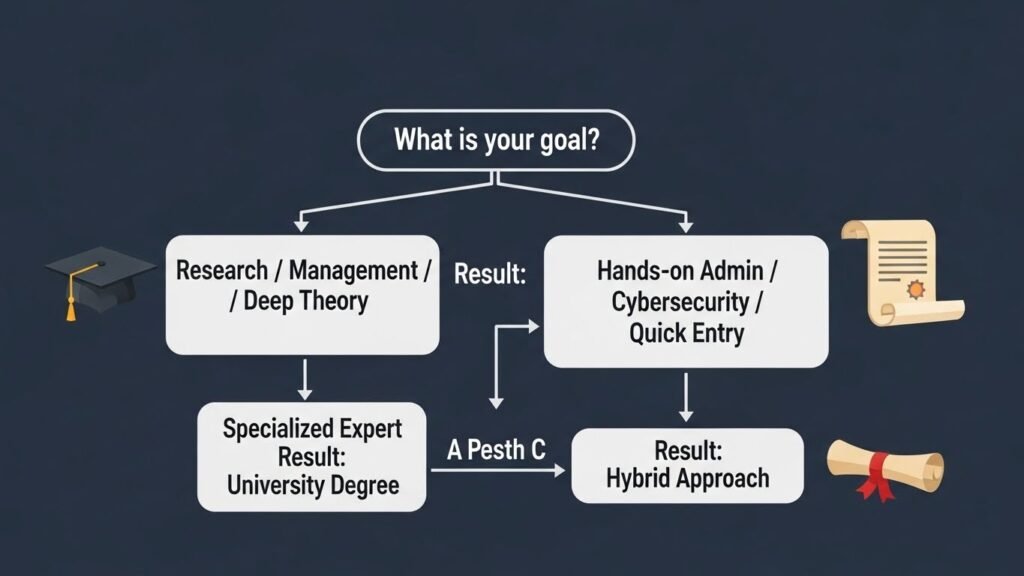
The answer isn’t a simple “one is better than the other.” It depends entirely on your goals, your budget, and the specific niche you want to enter. In this guide, we will break down the pros and cons of each path, analyze how AI is changing hiring standards, and provide a practical roadmap for breaking into the industry today.
The Case for the University Degree
Despite the rise of alternative education, the four-year degree is far from dead. It remains the gold standard for specific roles and organizations.
Deep Theoretical Foundation
Certifications teach you how to configure a router or write a specific script. A Computer Science degree teaches you why computers work the way they do. You learn algorithms, data structures, and the mathematics of computing. This deep knowledge is crucial if you want to be a software engineer building complex AI models or a data scientist designing new architectures.
The “HR Filter”
Let’s be realistic: many Fortune 500 companies and government agencies still use automated Applicant Tracking Systems (ATS) that automatically filter out resumes without a Bachelor’s degree. For management roles (CIO, CTO) or strict corporate environments, a degree is often a non-negotiable checkbox.
Networking and Soft Skills
The university provides a built-in network of peers, professors, and alums. It also forces you to develop soft skills—presentation, writing, and teamwork—that technical certifications rarely cover.
The Case for IT Certifications
If degrees are the marathon, certifications are the sprint. They are focused, practical, and responsive to market needs.
Speed and Cost
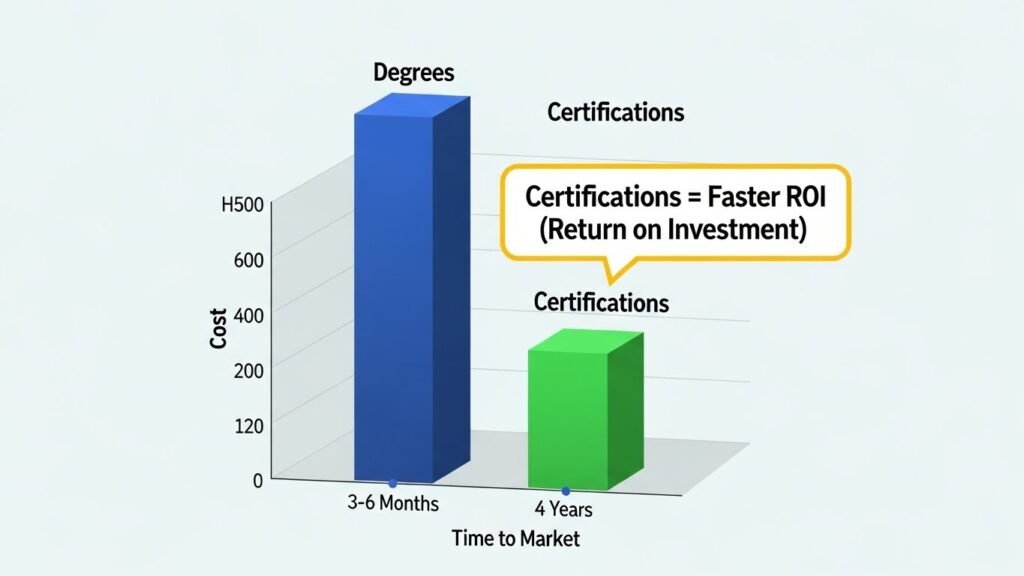
You can earn a foundational certification, such as CompTIA A+ or Google IT Support, in 3 to 6 months for under $500. Compare that to 4 years and potentially $40,000+ in tuition. For career switchers who need to start earning money quickly, certifications are the clear winner.
Validated Practical Skills
When an employer sees “Cisco CCNA” on your resume, they know exactly what you can do: you can configure a network. Degrees are often vague; certifications are specific. In hands-on fields like cybersecurity or cloud administration, hiring managers usually value a relevant certification over a general degree.
Staying Current
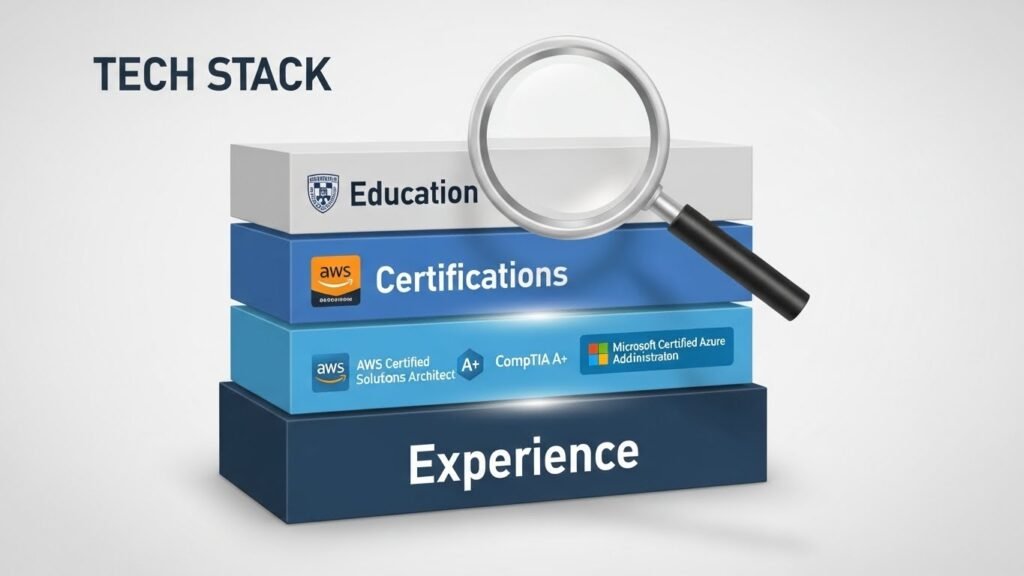
Technology changes faster than university accreditation boards can approve new classes. Certification vendors update their exams every 3 years. If you hold a current AWS Solutions Architect certification, an employer knows your skills are relevant today, not from a syllabus written in 2015.
The “AI Factor”: How Artificial Intelligence Changes the Game
In 2026, AI is not just a buzzword; it is a coworker. Tools like ChatGPT, Copilot, and automated coding agents handle basic troubleshooting and syntax generation. This shifts what employers are looking for.
The Death of Rote Memorization
Historically, IT pros were hired because they memorized command-line syntax. Now, AI can generate those commands in seconds. The value of an employee is no longer “knowing the answer”; it is “knowing the right question to ask” and validating the AI’s output.
Rise of the “Generalist”
Because AI handles the repetitive grunt work, junior IT pros are expected to handle more complex tasks sooner. You need a broader understanding of how systems connect. This actually favors the hybrid model of IT certifications vs. degrees: you need the theory to understand the big picture (Degree/Self-study) and the specific skills to implement the tools (Certs).
New “AI Literacy” Certifications
We are seeing a surge in AI-specific certifications for non-data scientists. Understanding how to secure Large Language Models (LLMs) or how to integrate AI APIs into existing infrastructure is becoming a critical skill set.
The Ideal Roadmap for 2026
So, what should you do? Here are three tailored paths based on your current situation.
Path 1: The “Career Switcher” (Fastest Entry)
- Goal: Get a job in IT Support or Help Desk within 6 months.
- Strategy: Skip the degree for now.
- Step 1: CompTIA A+: The industry standard for entry-level tech support.
- Step 2: Network+ or CCNA: Learn how the Internet works.
- Step 3: Start applying for jobs while building a home lab.
- Verdict: Certifications are 100% the way to go here.
Path 2: The “Future Architect” (Long-Term Growth)
- Goal: Become a Cloud Architect, DevOps Engineer, or Cyber Security Analyst.
- Strategy: A hybrid approach.
- Step 1: If you are young, get a Computer Science degree. The theory will pay off later.
- Step 2: While in school, get internships and earn specialized certifications, such as AWS Certified Solutions Architect or CompTIA Security+.
- Verdict: The degree opens the door; the certs get you the promotion.
Path 3: The “Budget-Conscious Learner”
- Goal: Maximize income with minimal debt.
- Strategy: Stackable Certifications + Experience.
- Step 1: Focus on high-demand niches like Cloud (Azure/AWS) or Cybersecurity.
- Step 2: Earn mid-level certs (e.g., CySA+, Azure Administrator).
- Step 3: Build a portfolio. Document your projects on GitHub or a personal blog.
- Verdict: Experience trumps degrees after your first job.